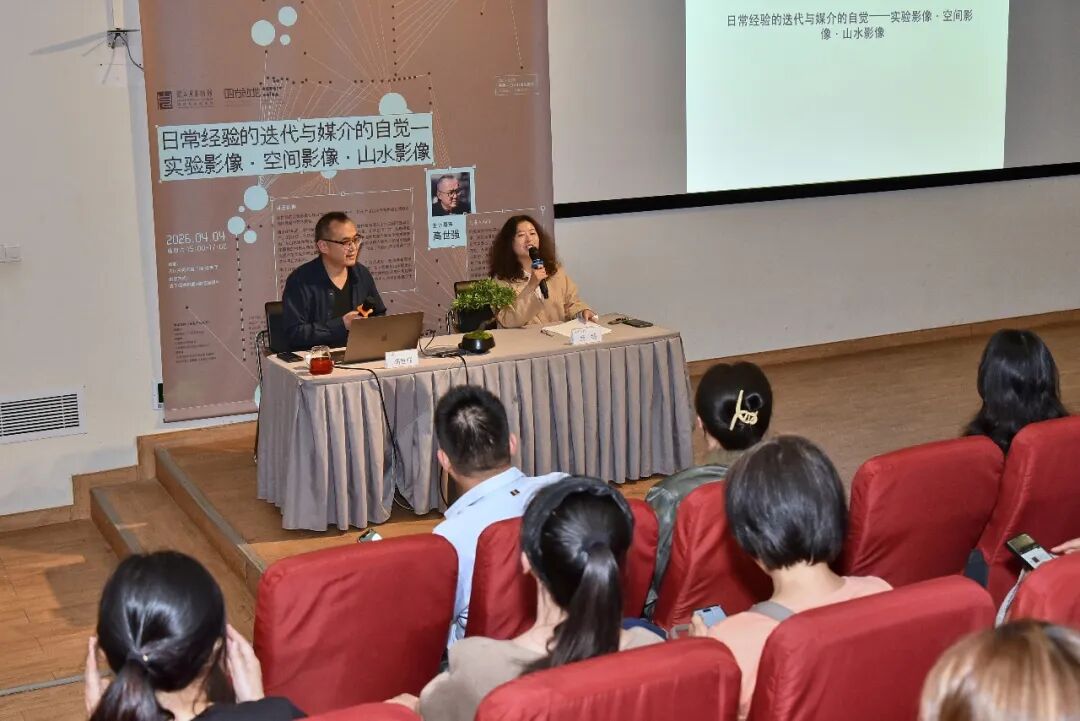
In the first lecture in 2026, Gao Shiqiang divided his personal creation into two stages: the experimental image exploration period (1995-2010) and the landscape image transformation period (2017 present), with the core theme of "iteration of daily experience and self-awareness of media". He presented a process of expansion from "individual self" to "historical self" and then to "cultural self", completing the artistic transformation from exploring the depth of reality to inheriting the spirit of landscape and intervening in future imagination.
Gao Shiqiang admitted that at the beginning of the lecture, he was worried about the low correlation between his own creation and the theme of "art that intervenes in society". Later, he realized that his artistic journey is a complete portrayal of individual artists' involvement in the world, from private expression to cultural responsibility. Artists are first and foremost individuals with independent perception and thinking, and their creative essence is information exchange and spiritual dialogue with the world. The exploration of landscape images elevates the individual's ego to the greater self that carries the spirit of Chinese culture, achieving deep intervention of art in society and civilization.
(1) Experimental imaging stage: Using individuals as probes to explore the depth of reality
In 1995, Gao Shiqiang became one of the first experimental image explorers in China. During the fifteen years until 2010, his creations focused on individual experience, historical cognition, and practical observation, using images as "probes to reality" and divided them into three creative dimensions:
One is to express ideas and concepts through images. Gao Shiqiang's early works focused on the intrinsic connection between personal emotions and social daily life, with his representative work "Farewell at 18" (2006) stemming from personal emotional confusion and observation of gender relationships in Chinese style families. He summarized family relationships as a "calm bad mood": the older generation sticks to their marriage during arguments, and morality and responsibility become the core of maintaining the family. This model is passed down from generation to generation, forming a unique Chinese style emotional structure. The work borrows cultural symbols from the legend of Liang Zhu, allowing the same group of actors to portray three pairs of characters: Liang Zhu, contemporary college students, and a farmer couple. They speak and confront each other in the mountains and waters, revealing the disconnect between traditional love narratives and real-life emotions, and reflecting on the regulation of cultural symbols on individual emotions.
Secondly, constructing personalized historical cognition through images. Around 2008, Gao Shiqiang focused on the modern and contemporary history of China, completing an independent interpretation of history through images, with representative works such as "Revolution" and "Red". "Revolution" is shot in the roof dump of Hangzhou, against the background of the social context of the real estate foam expansion, the game between the new left and liberalism in the ideological field. It contrasts the bright appearance of the city with the hidden "city buttocks", breaks the creative trend of "cold long lens" and "no plot confusion" of the artistic images at that time, and ridicules the nihility of human history, systems and values with a "talkative" dramatic expression. Finally, it completes the deconstruction of the historical narrative with the scene of security cleaning up the garbage. Gao Shiqiang emphasized that this stage of creation stems from the confusion of historical reading, and images have become a medium for independent thinking about history.
Thirdly, after using images as probes to look back on history, Gao Shiqiang returns to reality in his creations. He focuses on the living conditions of young people and social changes, with representative works such as "Eclipse of the Sun" and "Qingbang". The film 'Eclipse of the Sun' is set against the backdrop of the employment difficulties faced by college graduates. It draws inspiration from HR's aversion towards job applicants who say, 'Give me a pivot, I can move the earth.' Using a reverse performance technique, it portrays the confusion of young people as they step out of campus and fall into the social 'siege', capturing everyday symbols such as electric scooters and student dormitory items, reflecting the spiritual difficulties of young people in the era. Qingbang "is the final work of Gao Shiqiang's experimental imaging, which is a three screen imaging device. To film the industrial development in Zhoushan, Zhejiang, Gao Shiqiang went to Dongji Island in the open sea and encountered the abandoned Qingbang Island, which was once bustling like the "Potala Palace on the Sea", with cinemas, schools, and ultimately only a few elderly people left. The work uses long shots to record the desolation and poetry of islands, reflecting on the gains and losses in social development, and becoming a key transition from experimental imagery to landscape imagery.
Gao Shiqiang summarized that the core of the experimental imaging stage is "exploring the depth of reality", from individual emotions to historical cognition, and then to reality observation, always with "individualized self" as the core, comparing artists to "nerve endings in the world" to sensitively capture the texture of the times. But after 2010, his creation entered a highly mature and repetitive period, where he "knew the appearance of the work before creation", lost uncertainty and adventure, and stopped writing for seven years, waiting for a new beginning of creation.
(2) Landscape Image Stage: From Landscape Spirit to Cultural Breakthrough in the Near Future
In 2016, Gao Shiqiang was awakened by landscape imagery and resumed his creative work in 2017. He shifted his focus to landscape imagery and spatial narrative, proposing the core concept of "three times and three times of landscape", completing the transformation from individual expression to cultural inheritance, and responding to the theme of "art that intervenes in society".
Three Times of Landscape: Scene - Dojo - Theater. Gao Shiqiang divides the creation and dissemination of landscape images into three progressive levels, forming a complete cultural intervention logic. Landscape Scene: The original state of the creation of heaven and earth, the natural essence that no one steps on, perceives, or expresses, is the material source of the spirit of landscape. Shanshui Daochang: Chinese people carry cultural genes and the spirit of mountains and waters. When facing real mountains and waters, the connection between heaven and man is not only a physical feeling, but also a resonance of the "cultural body". It is the attachment and reverence for mountains and waters engraved in Chinese genes. Shanshui Theater: Bringing the perception and creation from Shanshui Dojo into modern cities such as Shenzhen, allowing busy urbanites to encounter mountains and waters in the exhibition hall, connecting traditional spirit with contemporary life. This is the core carrier of art intervention in society.
Landscape Action: a dialogue between embodied practice and traditional cultural context. The creation of landscape images is centered around the "Landscape Action". The team has been deeply involved in landscape scenes such as Taihang Mountain, Zhongnan Mountain, and Yanziling Fishing Platform for a long time, following the creative principle of "grabbing density" - capturing the softest and most poetic half hour of light before 6:30 in the morning and after sunset in the evening. Creation is not a simple record of natural scenery, but rather adheres to Shi Tao's concept of "searching for all the strange peaks and sketching", reconstructing mountains and waters through temporal and spatial montage: materials are taken from specific mountain peaks, but are not limited to a single real scene, integrating Song painting composition and brush and ink rhythm to create the "landscape of the mind" rather than the physical meaning of mountains and waters. The representative work 'Taihang Mountains' took three years to shoot, combining the desolate and majestic landscape of northern China with visual elements of Song painting, presented in the entire wall space, creating a stunning on-site experience and paying tribute to nature. Gao Shiqiang emphasized that landscape images are not landscape photography, landscape films, or movie mirrors, but rather cultural constructions that carry China's views on heaven, earth, universe, life, and poetic heritage.
Gao Shiqiang pointed out that imaging equipment, as an invention after the Western Renaissance, has its own limitations of anthropocentrism and focal perspective worldview: the lens takes the human perspective as the center, compressing and flattening mountains and waters, while Song painting brushwork can better present the true scale and spiritual charm of mountains and waters. For example, in the real-life scenes of "Journey to the Mountains and Streams" and "Kuanglou", the grandeur of the embodied feeling contrasts strongly with the narrowness of the camera shooting. The "realism" of the camera is only suitable for human scale, and it loses its authenticity when facing mountains and waters. To this end, his landscape images explore the medium transformation of "spatialization and spatialization": integrating the temporal aesthetics of hand scrolls into the images, breaking the limitations of single frame space; Transforming the brushwork rhythm of Huang Binhong's paintings into the temporal rhythm of images, reconstructing the spirituality of mountains and waters through non-linear editing, overcoming the constraints of the Western worldview of the camera, and achieving cultural self-awareness of the media.
Gao Shiqiang systematically explained the connotation of the spirit of mountains and waters, the creative response in the AI era, and the path of artistic intervention in the future in response to audience questions, forming a highly academic core viewpoint.
(1) The essence of the spirit of mountains and waters: a continuous civilization view integrating Confucianism, Buddhism, and Taoism
Gao Shiqiang is clear that his exploration of landscape imagery is not retro, but rather as a contemporary artist, exploring traditional spirit to address the crisis of modernity. The spirit of mountains and waters is a concrete expression of the fusion of Confucianism, Buddhism, and Taoism, with the core concept of the continuity of "unity of heaven and man", which is different from Western scientific progressivism, atomized individualism, and capitalist logic. Confucian ethics: The main mountain, secondary mountain, and subject mountain structure in landscape painting embodies the ethical order of monarch subject, primary and secondary, and yielding, which is the unity of morality and aesthetics, rather than the physical space of Western geometric composition. Taoist ecology advocates that "heaven and earth coexist with me, and all things are one with me", breaking the subject object opposition between humans and nature, and is a concept of a community of life that transcends environmentalism. Zen Poetry: The Three Distant Methods are not only spatial techniques, but also the distance of the soul, the distance of seclusion, and the distance of the world, achieving the integration of spirit and nature. Western modernity revolves around individualism, progressivism, and capitalism, leading to "modern diseases" such as atomized survival, jungle rule, and ecological crisis; The Chinese landscape spirit represents a form of civilization characterized by moderation, continuity, and coexistence, emphasizing the harmonious coexistence between humans and nature, as well as between individuals. It is an important resource for addressing contemporary spiritual scarcity and cultural dilemmas.
(2) Landscape Creation in the AI Era: Embracing Technology and Adhering to Cultural Core
Faced with the impact of AI technology on the mimicry of mountains and waters, Gao Shiqiang holds an open but cautious attitude: the spirit of mountains and waters is not limited to media, from rock paintings, portrait bricks, landscape poetry, landscape paintings to landscape photography, imaging, and AI generation, it has always been the carrier of Chinese worldview, and media iteration will not dissolve its core. The limitation of AI is that it is based on the concatenation of past data and cannot create a true new landscape spirit, while human embodied feelings, cultural insights, and spiritual creation are irreplaceable. Future creations will integrate digital technologies such as CG and AI, but always adhere to the creative logic of "searching for all the peaks and making drafts", leading technology with cultural spirit rather than being alienated by technology.
(3) The Three Realms of Artistic Creation: Competition, Exploration, and Tao Ran
Based on his own creative process, Gao Shiqiang summarized three forms of artistic creation, which not only answer the questions of ordinary audiences, but also provide inspiration for art enthusiasts. Competitive creation is the mainstream state of young artists, pursuing to stand out in exhibitions and attract attention with creativity and personality, which is a necessary stage for artistic growth. Seeking creativity is the core mission of artists to respond to inner confusion and world problems through art, and to reflect on history, reality, and life through creation. Tao Ran style creation: transcending utilitarianism and evaluation, obtaining spiritual pleasure through creation, enjoying the process of coexisting with mountains, waters, and media, is the ultimate state of art.
(4) Future outlook: Exploring through action, without predetermined boundaries
Regarding the future form of landscape art, Gao Shiqiang opposes speculative predictions and advocates for "replacing imagination with action": future landscape art will be presented through multiple media such as digital technology, spatial installations, immersive images, and integrated into cutting-edge fields such as metaverse and ecological art, but always centered on embodied experiences and cultural spirit.
Creation should force oneself into ignorance, abandon existing experience and inspiration, explore innovation in the unknown, and avoid being bound by past memories and paradigms. The spirit of mountains and waters will participate in the game of imagination in the near future: contemporary reality is the landing of Hollywood's sci-fi imagination in the last century. In the future, the spirit of Chinese mountains and waters should be integrated into popular culture, visual art, and technological design to create a future civilization form that belongs to China, such as magical films and immersive mountain and water spaces based on Song paintings, and to build the discourse power of future culture.
After the lecture, academic host Xue Yang summarized that Gao Shiqiang's creative exploration answered three core questions: What is landscape? Where is the landscape? What is the essence of Chinese landscape spirit? Mountains and waters are not only natural mountains and waters, but also the Chinese people's views on life, the world, culture, and philosophy. They are the spiritual foundation engraved in their genes. The iteration of Gao Shiqiang from experimental images to landscape images is essentially the sublimation of daily experience and cultural consciousness of media. It is the growth from individual expression to cultural responsibility, and also the practice of art intervention in society, resisting technological alienation, and rebuilding spiritual connections. In the era of AI, the value of art lies not in the dazzling technology, but in the tangible experience, humanistic thinking, and cultural spirit that safeguard the warmth of humanity and the roots of civilization.