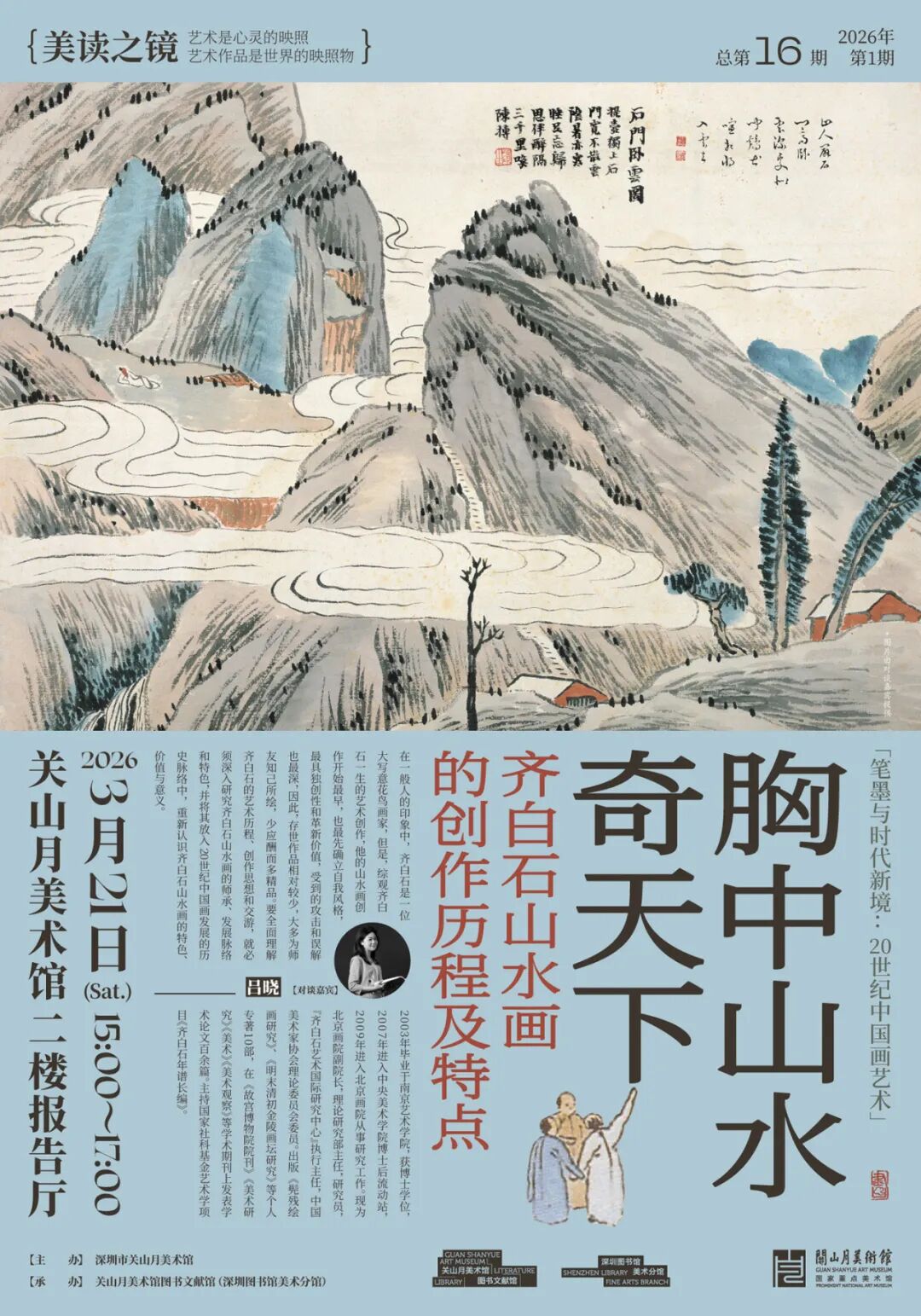
The 20th century was an important turning point for Chinese painting from tradition to modernity. Faced with the new context formed by the great changes of the times and cultural transformation, a group of outstanding artists have rethought the traditional brush and ink of Chinese painting and its relationship with the times in their own different ways. While inheriting the traditional spirit, they constantly explore new expression paths. The "Mirror of Beautiful Reading" series of academic lectures in 2026 will be themed "Ink and the New Era: Chinese Painting Art in the 20th Century". Through case studies of five artists, Qi Baishi, Huang Binhong, Fu Baoshi, Gao Jianfu, and Guan Shanyue, this lecture will explore how Chinese painting achieved creative transformation on the basis of profound tradition in the 20th century, and re-examine the rich practices of Chinese painting between inheritance and innovation during this period. From Qi Baishi's unique and imaginative landscapes to Huang Binhong's rich and colorful brushwork realm; From the era atmosphere presented by Fu Baoshi to the innovative practices advocated by Gao Jianfu and Guan Shanyue of the Lingnan School of Painting, this series of lectures will use specific works as clues and historical contexts as references to present the creative development and new frontiers of Chinese painting in the turbulent times. The fifth lecture will invite senior experts in relevant research fields to give special presentations, and together with the audience, we will explore this creative and thought-provoking process of art history. The first lecture of 2026 will be given by Researcher Lv Xiao, Vice President of Beijing Academy of Fine Arts and Head of Qi Baishi Art International Research Center. The topic is "The Creative Process and Characteristics of Qi Baishi's Landscape Painting: A World of Strange Mountains and Rivers in the Heart", leading the audience into the unique world of Qi Baishi's landscape painting and experiencing the ingenuity and artistic conception contained in its brushwork.
In the general impression, Qi Baishi is a freehand flower and bird painter. However, looking at Qi Baishi's artistic creations throughout his life, his landscape paintings began earliest, established his own style, were the most original and innovative, and suffered the deepest attacks and misunderstandings. Therefore, there are relatively few surviving works, mostly painted by teachers, friends, and close friends, with fewer social engagements and more exquisite works. To fully understand Qi Baishi's artistic process, creative ideas, and social interactions, it is necessary to conduct in-depth research on the lineage, development trajectory, and characteristics of Qi Baishi's landscape paintings, and place them in the historical context of the development of Chinese painting in the 20th century, re understanding the characteristics, values, and meanings of Qi Baishi's landscape paintings.
In 2018, Beijing Academy of Fine Arts planned "The Strange World of Mountains and Rivers in the Chest - The Landscape Artistic conception under Qi Baishi's pen (Part 2)" and edited and published the album "The Strange World of Mountains and Rivers in the Chest - Collection of Qi Baishi's Landscape Paintings", which collected nearly 200 pieces of Qi Baishi's landscape paintings from more than ten collection units across the country (the collection also included dozens of Qi Baishi's landscape paintings from the Czech Republic, Japan, and the United States), as well as more than 50 landscape paintings collected by Beijing Academy of Fine Arts. For the first time, it presented the development of Qi Baishi's landscape paintings in a relatively complete way, fully demonstrating his originality and innovative significance in landscape painting creation.