2025-12-15
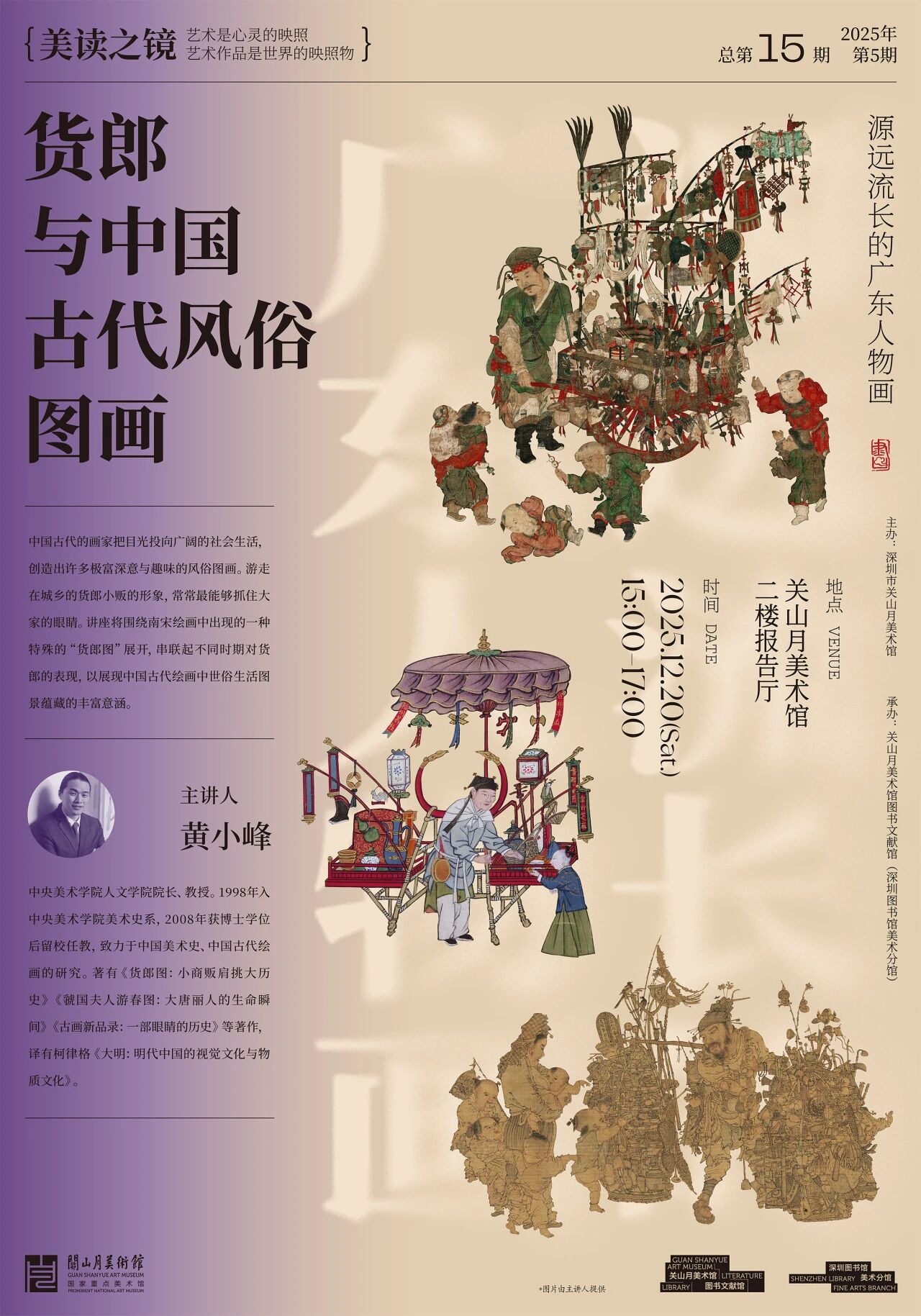
2025 is coming to an end. Through a year of sharing, the "Mirror of Beauty Reading" series of lectures takes everyone into the long time tunnel of Chinese figure painting, following four speakers through the long corridor of Tang, Song, and Yuan dynasty figure painting, gradually entering the path of Guangdong figure painting, and seeing the evolution and development of Guangdong figure painting from the Ming and Qing dynasties to the 20th century. Along the way, the scenery is beautiful and refreshing. Chinese figure painting encompasses a wide range of subjects and is profound and extensive. Looking back at its past, there are always some shining points that make people linger and forget to leave. In the fifth lecture, we will extract one of them and unfold it layer by layer to provide the audience with a detailed explanation. On December 20th, Mr. Huang Xiaofeng, Dean of the School of Humanities at the Central Academy of Fine Arts and a scholar of art history, will open another door for Shenzhen audiences to appreciate figure paintings under the theme of "Freight Forwarders and Chinese Customs Paintings". Through the special character image of freight forwarders and street vendors wandering in ancient urban and rural areas, he will showcase the rich connotations of secular life scenes in ancient Chinese painting.
What is genre painting? It is a painting with the themes of ordinary people's daily life, festival ceremonies, production labor, weddings, funerals, and various aspects of the market, which can be found both in ancient and modern times in China and abroad. Tracing back to the history of Chinese painting, the prototype of genre painting can be seen in the Han Dynasty portrait bricks, which involve activities such as singing, dancing, feasting, hunting, farming, and mulberry. There are records of genre paintings in the Tang Dynasty. Zhang Yanyuan wrote in the "On the Application and Extension of Painting Techniques" section of "Records of Famous Paintings of Various Dynasties" that "there is a unique type of painting that depicts the life of farmers in the fields, which has been unique since ancient times." This indicates that in the Tang Dynasty, people had already regarded genre paintings as an independent painting genre. During the Sui and Tang dynasties, there was a rich creation of genre paintings, mainly depicting the daily and traveling lives of wealthy ladies and nobles, with a focus on depicting vivid and elegant character images. Because genre paintings mainly depict human activities, they are often indistinguishable from character paintings that depict 'I am in you, you are in me'.
The golden period of the development of ancient Chinese genre painting was from the mid to late Northern Song Dynasty to the Southern Song Dynasty. During this period, works covered a wide range of themes and had numerous contents, and painting techniques reached a peak that was difficult for later generations to reach. The most famous one was undoubtedly "Along the River during the Qingming Festival" (in the first lecture on "The Mirror of Beautiful Reading" in 2024, researcher Yu Yu from the Palace Museum gave a detailed interpretation, and here is a review of the lecture). Customs paintings such as "Along the River during Qingming Festival" and "The Merchant" not only depict characters, but also meticulously depict the scenery, city walls, markets, commodities, and goods of that time, covering everything and encompassing everything.
Huang Xiaofeng, Dean and Professor of the School of Humanities at the Central Academy of Fine Arts. In 1998, he joined the Department of Art History at the Central Academy of Fine Arts. After obtaining his doctoral degree in 2008, he stayed on as a teacher and devoted himself to the research of Chinese art history and ancient Chinese painting. He has written works such as "The Picture of a Merchant: A Small Merchant Shoulders Carrying a Big History", "The Spring Outing Picture of the Lady of Guo State: The Life Moments of Tang Dynasty Beauties", and "New Collection of Ancient Paintings: A History of Eyes". He has also translated "The Ming Dynasty: The Visual and Material Culture of Ming Dynasty China" by Ke Luge.
In 2021, the National Palace Museum in Taipei held a special exhibition titled "Painting Linlang - The Painting of Freight Forwarders", showcasing various types of freight forwarder paintings from the Song, Yuan, Ming, and Qing dynasties, with a focus on Li Song's "Playing with a Baby in the Market" (also known as the "Freight Forwarder Painting") from the Southern Song Dynasty. What is a peddler chart? Freight forwarders were ancient street vendors selling groceries. They carried cargo or pushed unicycles through the streets, hand cranked drums, and often sang melodious and gentle songs to attract customers and introduce products. The peddler carries a stack of goods, including daily necessities, rouge and powder, as well as toys, candies, farm tools, and even bird lanterns, medicinal paper flags. It can be said that there is a dazzling array of goods, often becoming a scenery in the village streets and alleys. The custom painting depicting this type of peddler's stall is called the "peddler's painting". Famous ones include Su Hanchen's "peddler's painting" from the National Palace Museum and Li Song's "City Carrying Baby Playing Painting" from the National Palace Museum in Taipei. The Shanglang painting is a highlight of Song Dynasty folk paintings, which reached its peak in the Ming Dynasty. Even palace style image styles appeared, such as "selling birds and sparrows" and "Huaxiahuolang carrying", with exquisite and delicate depictions, numerous items, and vivid characters. After the Qing Dynasty, it was difficult to find the theme of "peddler paintings" in palace paintings. However, it is worth mentioning that Qianlong, as a ruler, annotated two paintings of Li Song's "peddler paintings" for the first time, which shows the importance of this painting in the mind of this emperor who was known for his collection.
Li Song, born in Qiantang (now Hangzhou) during the Southern Song Dynasty, came from a poor family. He was later adopted by the court painter Li Congxun and began studying painting. Li Song was skilled in painting various subjects such as figures, Taoist interpretations, customs, boundary paintings, and landscapes, and is well-known for his painting "The Merchant Boy" in later generations. There are four paintings under Li Song's name, the "Freight Forwarder Painting", which are small horizontal scrolls collected by the Palace Museum. Professor Huang Xiaofeng, the speaker of this issue, called them the "Beijing Edition". The "Palace Museum" in Taipei has a group fan painting "Freight Forwarder Painting", also known as the "Taipei Edition". The other two paintings are also group fans, which are collected at the Metropolitan Museum of Art in New York and the Cleveland Museum of Art in the United States, respectively, and are called the "New York Edition" and "Cleveland Edition" by the speaker. Although these four works are small in size, the precision of their depictions is breathtaking, which shows Li Song's skill in "boundary painting".
The "Beijing Edition" is the most complex depiction among the four works. On the right side of the picture, there are two old willow trees growing on the soil slope, showing the peddler coming to a remote countryside. On the left side, the peddler carries a cargo truck, and the dazzling array of goods immediately attracts wet nurses and children. They run over, and the children play and frolic with different postures. Even the dogs at home come to join in the fun, breaking the tranquility of the countryside. The entire painting is filled with a joyful and humorous atmosphere.
The "Taipei Edition" depicts intricate scenes, often using "nail head and mouse tail" to outline clothing patterns. Its technique and precision are the highest in Li Song's "Merchant Painting" series, and its preservation is also the best. The painting has the author's inscription "Jiading Gengwu Li Song Painting".
Li Song's four paintings of peddlers are all lightly colored, almost white drawn. In the Ming Dynasty, the "peddler paintings" became more exquisite, with vivid character depictions, gorgeous colors, and highly decorative. The painting "The Merchant Boy" in the collection of the Palace Museum is a typical pattern of "selling birds and sparrows". A peddler is depicted displaying shelves. The shelves made of bamboo are not ordinary peddler stalls that wander the streets, but are decorated with luxurious bird cages filled with various colors of birds, as well as children's favorite masks, dolls, pendants, and other items. Four young children play next to the peddler stalls. This work is a special type of peddler painting in the Ming Dynasty court. Court painters drew such peddler paintings with more consideration for decorative effects and to create a festive atmosphere. The lecturer believed that both the "merchant" image created by Li Song and the "merchant" of the Ming court implied the atmosphere of the Yuanxiao (Filled round balls made of glutinous rice-flour for Lantern Festival) Festival. Although they were delicately depicted, they had some contrast with real life, and were all products of the dramatic imitation idea.
The Ming Dynasty's "peddler paintings" also incorporated depictions of daily life scenes of the people. For example, Lv Wenying's "peddler painting" (a pair of paintings) is collected at the University Art Museum of Tokyo University of the Arts and the Negtsu Art Museum, both of which are composed of a peddler and four young children. The character painting is exquisite, the clothing lines are delicate, the face is finely hooked and painted, and the colors are bright. The two paintings of the peddler are both in the style of the Ming Dynasty palace system, with the peddler frame placed under a tree in front of the courtyard. In addition to the figures and trees, they depict a crane and a cat respectively, with detailed outlines, reflecting the customs and people of the Ming Dynasty. Han Sheng, a Ming Dynasty court painter from the Genjin Art Museum, depicted a group of children playing and frolicking around a peddler's stall in his painting "The Picture of a Salesman", which even includes images of kicking shuttlecock.
The speaker believes that ancient Chinese painters turned their attention to the vast social life and created many meaningful and interesting folk paintings. The image of a peddler wandering between urban and rural areas often catches everyone's eyes the most. This lecture will lead the audience to start from the unique painting theme of "peddler painting" and re-examine the circulation and changes of ancient figure painting. From this, we can not only glimpse the traditional customs and social style of the time, but also explore the rich connotations of Chinese figure painting. Let's follow the speaker to explore one by one.