2025-10-14
Since the Qing Dynasty, Guangdong painting has been known for its flower and bird paintings, as well as landscape paintings, while figure paintings have been relatively weak. As is well known, the development of Guangdong painting industry entered a debate and movement on the improvement of traditional Chinese painting in the early 20th century. In this era of great change, Guangdong figure painting has quietly undergone changes, no less than other painting disciplines, with the emergence of a fusion of various concepts and techniques from ancient and modern times, both domestic and foreign. Some painters, such as Huang Shaoqiang, simplify traditional techniques and integrate Western painting methods in their figure paintings, with a focus on the suffering of the people as the main theme, still following the traditional value of "enlightenment"; Some painters, like Fang Rending, use Western painting sketching methods as the basis for their figure paintings, cleverly utilizing traditional meticulous brushwork, line drawing, and color setting techniques to reveal modern aesthetics in realism. However, a more common situation is that many painters are versatile and skilled in both flowers, birds, landscapes, and figures. They can easily handle various subjects and have embarked on a path of transformation in figure painting that inherits tradition and is full of innovation in response to the development of the times. Guan Shanyue, a second-generation painter of the Lingnan School of Painting, is a typical representative of this trend.
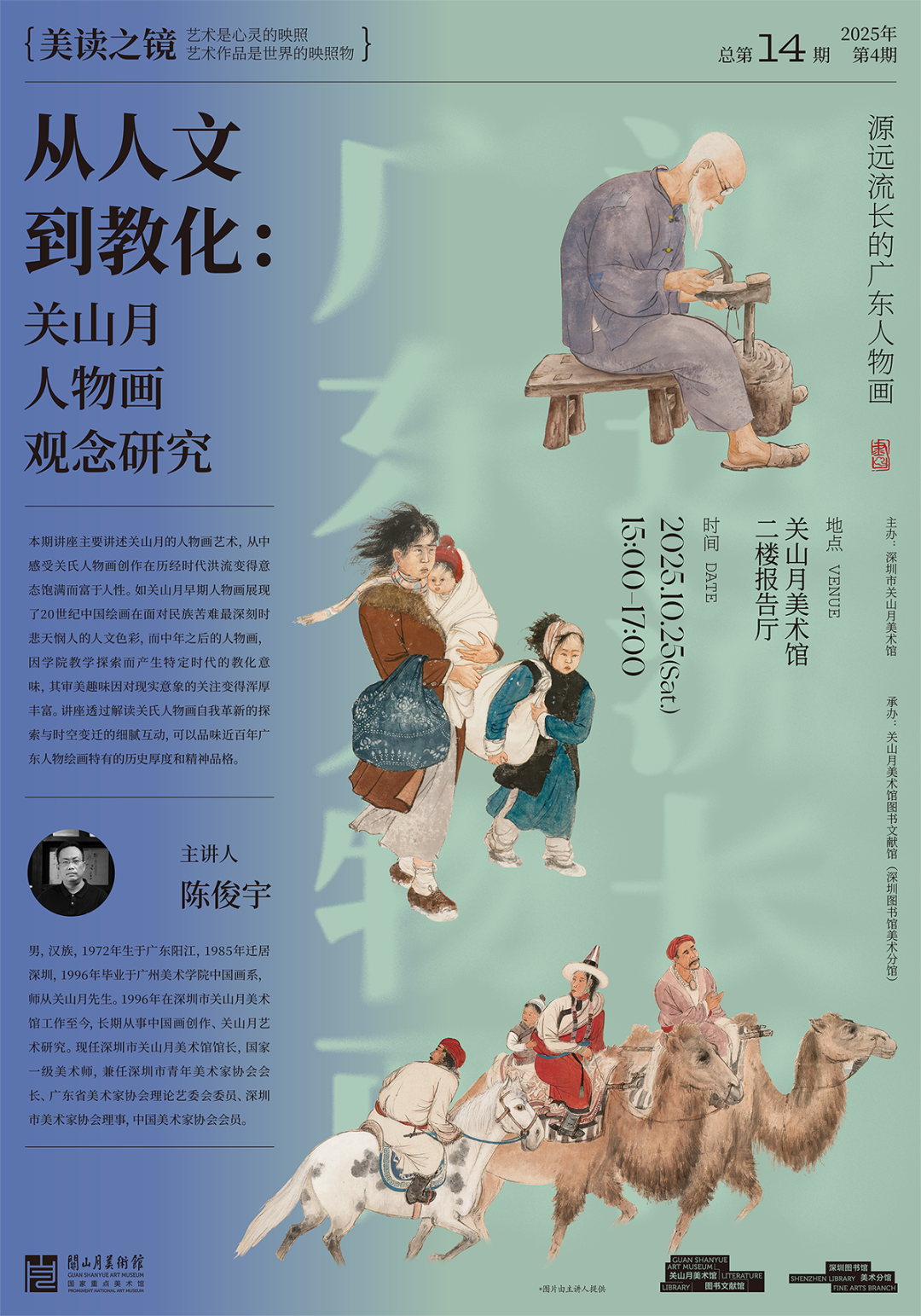
On October 25th, the "Mirror of Beauty Reading" series of lectures will hold its fourth session in 2025. Mr. Chen Junyu, the director of the Guanshanyue Art Museum in Shenzhen, will lead the audience to experience the new development of Guangdong figure painting in the 20th century under the theme of "From Humanities to Education: Research on Guanshanyue Figure Painting Concepts".
In 1935, 23-year-old Guan Shanyue became a disciple of Gao Jianfu. After the outbreak of the War of Resistance Against Japan in 1937, Guangzhou suffered 14 months of continuous bombing. Guan Shanyue first followed Gao Jianfu to Sihui, but later became separated from her teacher and wandered to Macau for more than two months before reuniting with her teacher. During her time in Macau, Guan Shanyue lived with Gao Jianfu at Puji Temple, carefully copying ancient paintings. Influenced by her high school teacher, Guan Shanyue also revered Song paintings. His distant teachers, Yan Wengui, Xu Daoning, and others, had extensive experience in depicting cold forests and snowy landscapes, as well as fishing and hunting in streams and mountains. This experience laid the foundation for traditional painting of Guan Shanyue, and his landscape paintings often imitated the artistic conception of the Song Dynasty. The observations and experiences during the escape left a deep impression on Guan Shanyue. Although she was unable to devote herself to defending the country on the battlefield, the painter insisted on using his paintbrush to record the national crisis, "holding up the book of the calamity of the Japanese pirates to show that we must not forget our national humiliation! Let's talk about the history of the painting. In his works during this period, Guan Shanyue depicted scenes of wartime suffering from various angles, including his expertise in mountains, waters, and ships. However, the most interesting aspect of his works was his portrayal of fleeing characters. From the perspective of a painter, he expressed his humanistic concern for the suffering of his fellow countrymen during wartime through character portrayal.
In the famous film 'Retreat from the City', the close-up of withered trees and snow, and the distant view of mountain and forest houses all tell the audience that this is a vast snowy landscape. However, in this 7-meter-long scroll, Guan Shanyue depicts a long line of refugees in the foreground position of the picture, interspersed among river scenery, roads, bridges, and mountains, walking from the city to the mountains. More than twenty fleeing civilians walked on the crude wooden bridge in the middle of the painting, carrying or carrying their belongings, walking from right to left. The characters are depicted using traditional landscape painting techniques, which may seem like simple brushstrokes, but are vivid and natural, with different postures, reminiscent of the Song Dynasty's "travel pictures". In Xiao Zhao's "Journey to Guanshan" of the Southern Song Dynasty, a group of horses were depicted walking from near to far, symbolizing the scene of the Northern Song Dynasty's refugees fleeing. The crowd depicted by Guan Shanyue in this work is a refugee team. Unlike Xiao Zhao's arrangement of the expedition in a corner of the picture, Guan Shanyue places the fleeing characters in the most important position, with a large number of people crossing the entire picture. The urban buildings at the right end of the picture and the wild fishing on the deserted beach at the left end echo the theme of escaping from the city to the countryside. Although 'Retreat from the City' cannot be strictly considered a figure painting, there is no doubt that this work highlights the painter's new thinking on figure painting. Characters are not only the 'embellishments' of landscape painting, but also the subject of narrative. Figure painting is even more conducive to depicting wartime suffering than other painting genres. It can be said that Guan Shanyue's creation of anti Japanese war themes during this period gradually focused his interest on figure painting. This is not only a tribute and development to the study of Song painting's "travel map", but also his true creative ideas that emerged during the war period.
Chen Junyu, male, Han ethnicity, was born in Yangjiang, Guangdong in 1972. He moved to Shenzhen in 1985 and graduated from the Chinese Painting Department of Guangzhou Academy of Fine Arts in 1996, studying under Mr. Guan Shanyue. I have been working at the Guanshanyue Art Museum in Shenzhen since 1996, and have been engaged in Chinese painting creation and Guanshanyue art research for a long time. The current director of Guanshanyue Art Museum in Shenzhen, a national first-class artist, also serves as the president of Shenzhen Youth Artists Association, a member of the Theoretical Art Committee of Guangdong Artists Association, a director of Shenzhen Artists Association, and a member of China Artists Association.
During the same period, 'The Fisherman's Robbery' depicted fishing boats in the midst of war, with the scene filled with smoke of gunpowder and fishermen panicking. The close-up on the right side of the screen focuses on a fisherman's mother trying to carry her child from a large ship to a small boat to escape. From the composition of the painting, it is evident that this work is no longer traditional Chinese painting, and narrative has become the goal that the painter strives for. He still uses traditional line drawing and coloring techniques, but expands the size of the characters in the painting, making the viewer immediately attracted to the characters in the painting. In some other individual works, Guan Shanyue began to try to create works with characters as the main body, such as "The Shoemaker" and "The House of the Guerrilla" created in 1939. From embellishment to subject, it reflects Guan Shanyue's transfer of interest and creative confidence in figure painting, and the transformation and innovation of painting techniques are contained within it.
In 1943, Guan Shanyue, along with his wife, Zhao Wangyun, Zhang Zhenduo, and others, went to Dunhuang to investigate and copy murals. As he traveled westward, his character paintings gradually changed, with fuller colors and stronger lines. The nomadic life of ethnic minorities often became his subject matter, but the unique humanistic color still runs through it.
After the founding of the People's Republic of China, Guan Shanyue devoted himself to teaching Chinese painting while insisting on creation. His figure paintings underwent another transformation on the basis of tradition, forming new creative concepts. He emphasized the expressive power of line drawing and lines, believing that line drawing should become the basic training for Chinese painting modeling. At the same time, he paid more attention to real life and created a large number of works depicting the people of the new era. Various industries and ethnic figures such as industry, agriculture, fishing, education, and military often became his subjects of depiction. During the period of Guan Shanyue, the composition of figure paintings gradually broke away from the traditional Chinese painting style, and often used photographic instant composition. The images were independent and complete, which was more conducive to ordinary people's viewing. The lines were vigorous and expressive, and the works had a unique function of educating the times.
In this lecture, the speaker will focus on Guan Shanyue's figure painting art, leading the audience to appreciate her figure painting works from different periods, and telling the story of how Guan's figure painting creation has gone through the tide of the times and become full of emotions and humanity. Comparing the humanistic colors depicted in his early figure paintings during times of national suffering with the educational implications arising from the exploration of college teaching in middle age, this study explores the conceptual changes behind it. The lecture interprets the self-renewal of Guan Shanyue's figure painting over time and space, and savors the unique historical thickness and spiritual character of Guangdong's figure painting over the past century.
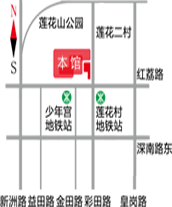
This lecture will be held on October 25th (Saturday) at 3:00 pm in the lecture hall on the second floor of Guanshan Yue Art Museum. On October 16th (Thursday) at 10:00, appointment registration will be open. Scan the QR code below and click on "Activity Reservation" to register. The "Mirror of Beauty Reading" series of lectures has always been popular among the public, and registration is enthusiastic. Please register in a timely manner at 10:00 on the day of the reservation opening to avoid missing out.